
 Discover new videos and
articles
Discover new videos and
articles 


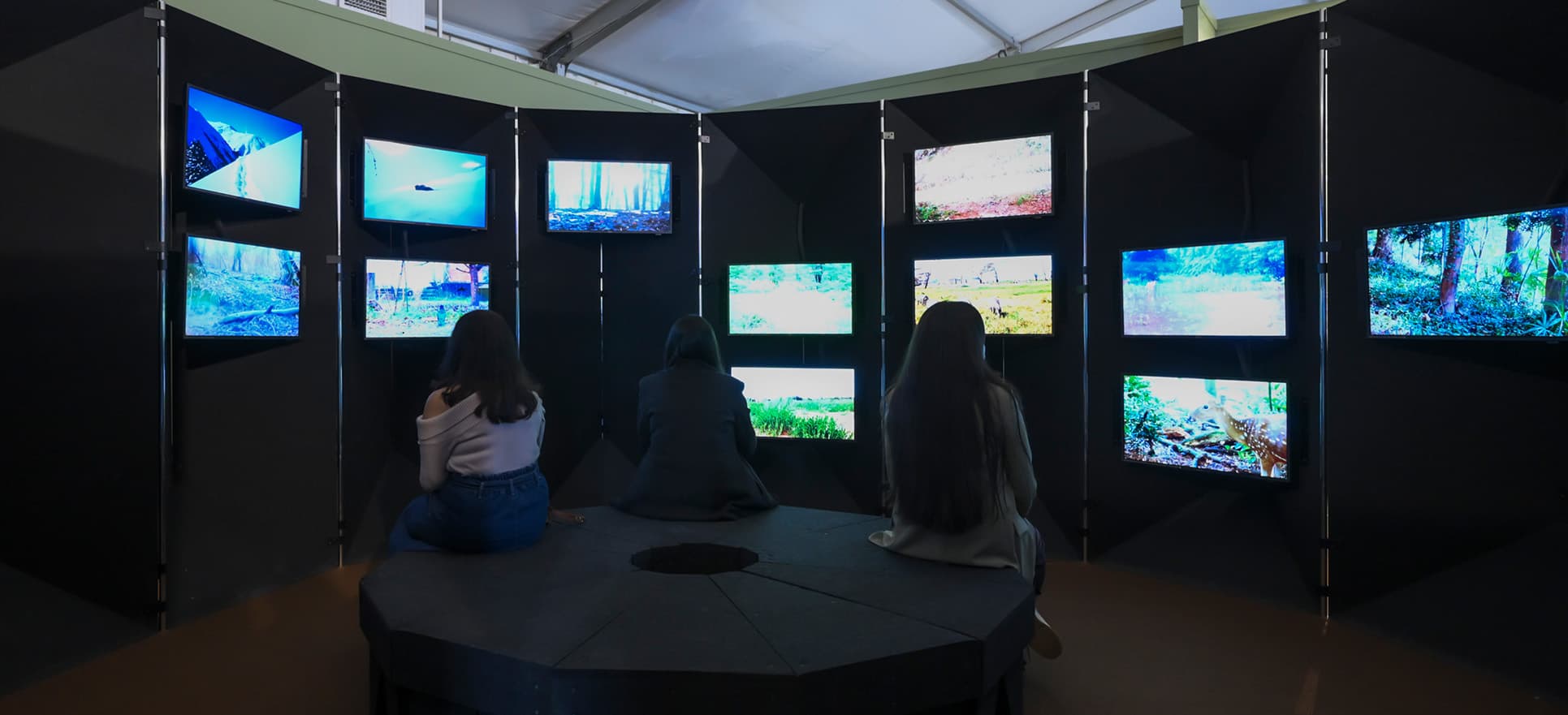
The Kiran Nadar Museum of Art (KNMA), The Embassy of Switzerland and The Habitats Trust are thrilled to present “Triggered by Motion”, a unique video installation, curated by Dr. Katharina Weikl, Head of Art X Science, University of Zurich. The installation includes videos of animals in their natural environment from 21 locations worldwide.
Open to the public until 25 July 2025, the installation will travel across Delhi NCR, with stops at KNMA Noida, Pacific Mall Tagore Garden, and Mall of India, Noida, making it freely accessible to diverse audiences across the city.
Conceived by the Art x Science Office, University of Zurich, this innovative exhibition captures videos in the wild using 21 motion-triggered cameras placed across 14 countries, offering a rarely seen perspective of wildlife. These cameras operated without any human interference, revealing an intimate and unfiltered portrait of natural life. Even in our absence, the human presence is quietly felt—reminding us of our impact on the planet. The videos, gathered over a year, are compressed into 20-minute capsules using artificial intelligence tools to make them more accessible.
The pavilion itself is also a testament to creativity, innovation and sustainable design. Designed by Boris Gusic, it is crafted from 33,000 PET bottles, recycled into sound-absorbing material by the Swiss company Impact Acoustic. In the centre of the pavilion are 12 small benches that can be pushed together to form an island from which the different recordings from different parts of the world can be viewed simultaneously. This unique installation transforms complex scientific research into an accessible and mesmerizing artistic experience.
Originally showcased at the Museum für Gestaltung in Zurich, ‘Triggered by Motion’ has since captivated audiences in DongdaeMun Design Plaza, Seoul, Swiss National Park, Zernez, Museum of Contemporary Art, Shanghai, Science Gallery Bengaluru, before its New Delhi debut in KNMA’s Learning Tent at India Art Fair 2025 (6 Feb 2025 – 9 Feb 2025).
The pavilion will also include a video installation of the artwork “Wiping Out” (2023) by Swiss artist Karoline Schreiber, showing the artist illustrating and erasing extinct animal species with a broom and black sand. The installation, powerful in its simplicity, symbolises the destructive influence of humans on the biodiversity of our planet.
This project reflects KNMA’s ongoing commitment to offering diverse, innovative learning experiences to the wider public. By bridging art, science, and community through accessible programming, interactive workshops, and multimedia storytelling, the museum continues to redefine the boundaries of traditional museum engagement and create inclusive platforms for exploration and discovery.
The project is supported by the Embassy of Switzerland in India and Bhutan under the biennale initiative of Sustainability with a plus.
“We are excited to bring this extraordinary exhibition to public spaces in Delhi” said Apurva Kackar, Director of Institutional Affairs and Outreach at the Kiran Nadar Museum of Art “By placing ‘Triggered by Motion’ in free and accessible public spaces, we’re breaking down traditional barriers to art and scientific exploration. This is not just an exhibition; it’s an invitation for everyone to experience the remarkable intersection of technology, conservation, and creativity.”
“Triggered by Motion, a Swiss walk-in video installation, demonstrates that wildlife monitoring without human intervention is possible. It showcases high standards of Swiss design with a commitment to sustainability. With Kiran Nadar Museum of Art and the Habitats Trust, we have found the ideal partners to bring this initiative to India,” commented Maya Tissa, Ambassador of Switzerland to India and Bhutan.
Rushikesh Chavan, Head, The Habitats Trust added “Triggered by motion is a powerful exhibition of how advancements in technology have transformed scientific discovery. From capturing elusive animal behaviours to now recording the very sounds of the forest, we’ve come a long way. The fusion of images, video, and acoustics is poised to open an entirely new chapter in wildlife conservation. It is not just about Science, it is Art.”
NOTES TO THE EDITOR
About KNMA
Established at the initiative of avid art collector Kiran Nadar in 2010, KNMA is a pioneering private museum of modern and contemporary art in South Asia, with branches in New Delhi and Noida. Supported by the Shiv Nadar Foundation, the not for-profit organization produces rigorous exhibitions, educational and public-focused programs, and publications. Through its rigorous and multiple programs, KNMA emphasises its commitment to institutional collaborations and support-networks for artists and creative communities, while extending its reach to diverse audiences. The museum houses a growing collection of more than 15,000 artworks from South Asia, with a focus on the historical trajectories of 20th century Indian art, alongside the experimental practices of young contemporaries. The new standalone building of KNMA is due to open in the next three to four years, near Delhi’s Indira Gandhi international airport.
The Embassy of Switzerland in India and Bhutan
As the official representation of Switzerland, the Embassy covers all matters concerning diplomatic relations with India and Bhutan. It represents Swiss interests in the areas of political, economic and financial affairs, legal affairs, science, education and culture. The Swiss diplomatic network in India and Bhutan, with the invaluable support of its sponsors, is proud to dedicate its 2025-2026 biennial campaign to the theme of “sustainability.” This campaign reflects our shared commitment to addressing one of the most pressing global challenges in a way that inspires, educates, and drives action.
https://www.eda.admin.ch/newdelhi
Research and Collaboration Partners
AFRICA
Kuruman River Reserve, South Africa: Prof. Dr. Marta Manser, Dr. Brigitte Spillmann, University of Zurich, Zoe Turner, Kalahari Research Centre
Lewa Wildlife Conservancy, Kenya: Dominic Maringa, Eunice Kamau, Timothy Kaaria, Lewa Wildlife Conservancy, Dr. Martin Bauert, Zurich Zoo
Moremi Game Reserve, Botswana: Dr. Gabriele Cozzi, University of Zurich, Dr. Peter Apps, Dr. Megan Claase, Botswana Predator Conservation
Nimba-Mountains, Guinea: Prof. Dr. Kathelijne Koops, University of Zurich, Nikki Buzzi, Zurich / Frankfurt am Main
Tarangire and Serengeti Ecosystems, Tanzania: Dr. Monica Bond, University of Zurich / Wild Nature Institute
ASIA
Chennai, India: Prof. Dr. Susy Varughese, Dr. Vivek Puliyeri, Indian Institute of Technology Madras
Cheorwon, South Korea: Dr. Choi Myung-Ae, Center for Anthropocene Studies, Korea Advanced Institute of Science & Technology (KAIST) / Yonsei University
Kastamonu, Turkey: Dilşad Dağtekin, Prof. Dr. Arpat Ozgul, University of Zurich, Dr. Anil Soyumert, Dr. Alper Ertürk, University of Kastamonu
Seoul, South Korea: Kim Gitae, Citizen Scientist
Shanghai, China: Dr. Li Bicheng, Shanghai Natural History Museum (Shanghai Science and Technology Museum)
EUROPE
Cerova, Serbia: Mihailo Stojanovic, Citizen Scientist
Engadin, Switzerland: Hans Lozza, Dr. Sonja Wipf, Swiss National Park
Fanel, Switzerland: Dr. Stefan Suter, WLS.CH / Zurich University of Applied Sciences
Gran Paradiso National Park, Italy: Dr. Alice Brambilla, University of Zurich, Alberto Peracino, Parco Nazionale Gran Paradiso
Zurich, Switzerland: Conny Hürzeler, Citizen Scientist, Dr. Madeleine Geiger, StadtWildTiere Zürich
OCEANIA
Oamaru, New Zealand: Philippa Agnew, Oamaru
NORTH AMERICA
Bolinas, USA: Jeff Labovitz, Susan Pace, Citizen Scientists
Palo Alto, USA: Bill Leikam, Urban Wildlife Research Project
Pasadena, USA: Dr. Markus Marks, University of Zurich / ETH Zurich / California Institute of Technology
Rolling WI, USA: Blayne Zeise, Jennifer Stenglein, Snapshot Wisconsin / USFWS Pittman-Robertson Wildlife Restoration Program
San José, USA: Dr. Dan Wenny, Dr. Yiwei Wang, SFBBO Coyote Creek Field Station Blue Penguin Colony
SOUTH AMERICA
Pedregulho, Brazil: Prof. Dr. Rita de Cassia Bianchi, Rômulo Theodoro Costa, São Paulo State University
Rio de Janeiro, Brazil: Dr. Natalie Olifiers, Universidade Veiga de Almeida
PROJECT TEAM
Lead: Dr. Katharina Weikl, Graduate Campus,University of Zurich
Assistance: Manuel Kaufmann
Project management: Leila Girschweiler, Anne-Christine Schindler
Computational biology: Laurens Bohlen
Mentor: Prof. Dr. Ulrike Müller-Böker, University of Zurich
Scientific advisor: Prof. Dr. Daniel Wegmann,University of Fribourg
Pavilion design: Boris Gusic Architects
Production CNC Operator: Dimitri Zehnder, Impact Acoustic
Video editing: Jan-David Bolt, Vanessa Mazanik, Lars Mulle, Vanja Tognola, Hadrami Yurdagün
Sound Design: Lars Mulle
The international network was developed with support of: swissnex San Francisco, swissnex Brazil, swissnex Boston, swissnex China, swissnex India, Swiss Science & Technology Office Seoul and the Swiss embassy in Nairobi. Impact Acoustic is credited for the production of the pavilion out of materials made with recycled PET.


